Logistics operations are entering 2026 under constant pressure. Customers expect faster delivery, accurate tracking, and fewer service failures. At the same time, labor shortages, fuel costs, and volatile demand are challenging traditional warehouse and transport models. This explains why automation is important in logistics operations.
The evidence is practical, not theoretical. DHL’s 2024 Logistics Trend Radar identifies robotics, artificial intelligence, and automated decision-making as major forces shaping supply chains. McKinsey reports that leading supply-chain organizations increasingly use advanced analytics and automation to improve planning, resilience, and productivity. The World Bank’s 2023 Logistics Performance Index also shows how reliability, shipment timeliness, and tracking visibility influence national logistics performance.
Automation can make these improvements visible on the warehouse floor. A conveyor can route a carton to the correct loading area. A warehouse robot can move inventory while workers focus on picking accuracy and exception handling. Transport software can compare delivery windows, traffic conditions, and vehicle capacity within seconds. Small gains accumulate.
However, automation is not a guaranteed solution. Poor data can produce faster mistakes. An expensive robot may underperform when product volumes change. People still need to supervise systems, manage unusual orders, and question unreliable recommendations. This is where experience matters. Companies should begin with measurable problems, such as repeated scanning errors or delayed replenishment, then test one process carefully.
The following discussion examines how to improve logistics operations with automation in 2026. It considers warehouse robotics, artificial intelligence, real-time visibility, workforce skills, implementation costs, and performance measurement. Progress may be uneven. That is worth acknowledging.
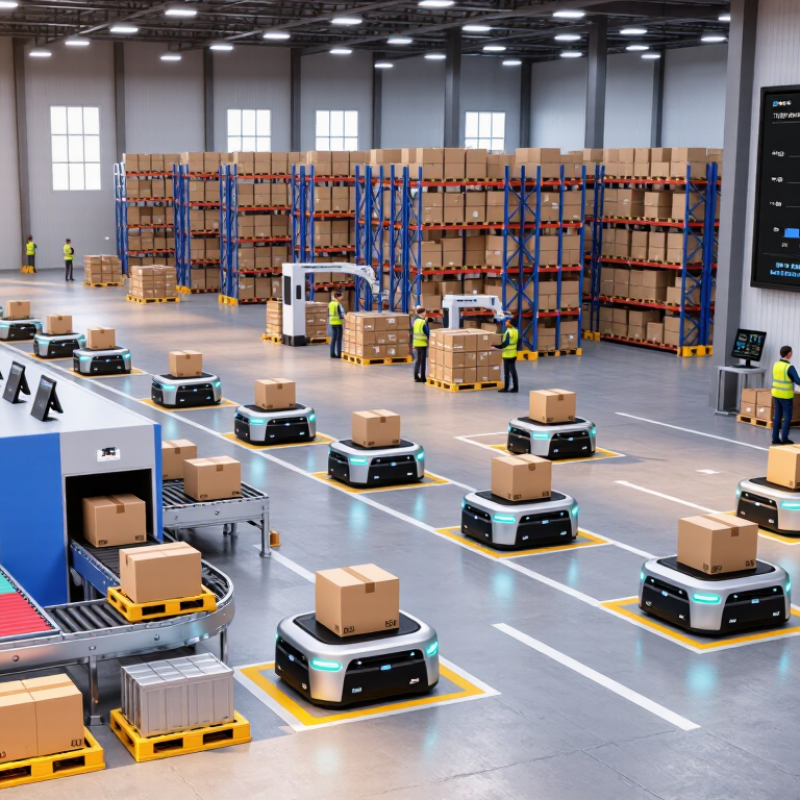
Automation’s role in logistics is larger than replacing manual labor. It connects orders, inventory, transport, and warehouse decisions through shared data. The 2024 Annual Industry Report from the Material Handling Industry association found that 55% of supply chain leaders planned to increase technology investment. The same report projects robotics and automation adoption to reach 53% within five years.
In practice, automation may begin with a barcode scan at 8:42 a.m. The system updates stock levels, assigns a storage location, and alerts a supervisor about a delayed pallet. Automated guided equipment can then move that pallet without waiting for a paper instruction. This reduces repeated data entry and makes exceptions easier to see. Small improvements matter.
However, automation is not a magic switch. Poor inventory data can make a fast system produce faster mistakes. A 2023 World Bank Logistics Performance Index report identifies tracking and tracing as a key logistics capability, yet many operations still depend on disconnected spreadsheets. That gap deserves attention. Companies should measure picking accuracy, order-cycle time, downtime, and exception-resolution speed before expanding automation. Human judgment remains necessary when demand changes suddenly or equipment behaves unexpectedly. I have seen teams automate a weak process and then struggle to explain the results. The better approach is modest: test one workflow, document the failure points, train operators, and adjust the design before scaling.
| Operational Dimension | Key Automation Use Case | Manual Baseline | Automated Operation | Change | Primary Business Impact |
|---|---|---|---|---|---|
| Order Processing Time | Order capture, validation and release rules | 18 min/order | 6 min/order | −66.7% | Faster order release and shorter customer lead times |
| Picking Accuracy | Barcode scanning, pick-to-light and guided workflows | 97.2% | 99.5% | +2.3 pts | Fewer returns, credits and customer service cases |
| Inventory Record Accuracy | Real-time warehouse management and cycle-count alerts | 92.0% | 98.0% | +6.0 pts | Better replenishment decisions and fewer stock discrepancies |
| Dock-to-Stock Time | Automated receiving, dimension capture and put-away tasks | 10.0 hr | 4.0 hr | −60.0% | Inventory becomes available for sale sooner |
| Order Cycle Time | Automated batching, wave planning and task allocation | 14.0 hr | 8.0 hr | −42.9% | More orders meet same-day or next-day dispatch targets |
| Labor Hours per Order | Conveyors, automated storage and optimized routing | 8.5 min | 5.5 min | −35.3% | Higher throughput without proportional headcount growth |
| On-Time Dispatch | Exception alerts, carrier integration and dock scheduling | 89.0% | 96.0% | +7.0 pts | Improved service reliability and delivery planning |
| Exception Resolution Time | Rule-based alerts and centralized control-tower visibility | 120 min | 45 min | −62.5% | Less downtime and faster corrective action |
| Manual Data-Entry Rate | System integration, OCR and electronic proof of delivery | 65.0% | 20.0% | −45.0 pts | Fewer transcription errors and lower administrative workload |
| Energy Use per Order | Automated lighting, route optimization and equipment monitoring | 0.80 kWh | 0.62 kWh | −22.5% | Lower operating cost and reduced emissions intensity |
Data note: The figures represent a normalized 2026 warehouse operating scenario for comparing manual and automation-enabled processes. Actual results vary by facility size, order profile, workforce model, system integration maturity and automation technology.
It connects orders, inventory, transport, and warehouse decisions through shared data. A barcode scan can update stock at 8:42 a.m. Small improvements matter.
Repetitive receiving, barcode scanning, approval workflows, and delivery updates are strong candidates. Choose tasks with high volume and repeated decisions.
Map each step from order release to delivery confirmation. Record timestamps, delays, rework, manual entries, and exception causes. Walk the warehouse floor.
Incomplete inventory records can make automated systems repeat mistakes faster. Compare system records with physical counts before expanding.
Track order-cycle time, picking accuracy, on-time dispatch, equipment uptime, and cost per order. Review results by shift and warehouse zone.
Start with one narrow workflow and establish baseline measurements. Train operators, document failure points, and set a rollback rule. Keep humans involved.
No. Automation may create faster errors when inventory data is incomplete. This assumption deserves regular review.
Workers can explain unusual delays, equipment behavior, and hidden queues. Their experience may reveal problems dashboards cannot explain. Listen carefully.
Change one factor at a time, such as conveyor speed or replenishment timing. Compare results for several weeks and review exceptions daily. Progress can be uneven.
Check whether accuracy improved despite slower speed. Investigate the trade-off before declaring failure. Some manual checks remain valuable.
Automation is becoming a central strategy for improving logistics operations in 2026. Understanding why automation is important in logistics operations helps organizations reduce repetitive work, improve accuracy, accelerate order fulfillment, and respond more effectively to changing demand. The process begins with reviewing current workflows, identifying delays and manual bottlenecks, and selecting suitable technologies for warehousing, transportation, and inventory management. Solutions may include automated data handling, smart scheduling, inventory tracking, and equipment that supports safer and more consistent operations.
Successful implementation requires more than purchasing technology. Businesses should connect new systems with existing processes, test performance in stages, and provide practical training for employees. After deployment, managers should measure results through indicators such as processing speed, order accuracy, inventory visibility, operating costs, and service reliability. Regular reviews and continuous adjustments ensure that automation remains useful, flexible, and aligned with business goals while allowing employees to focus on decision-making and higher-value tasks.

 IDD Motion