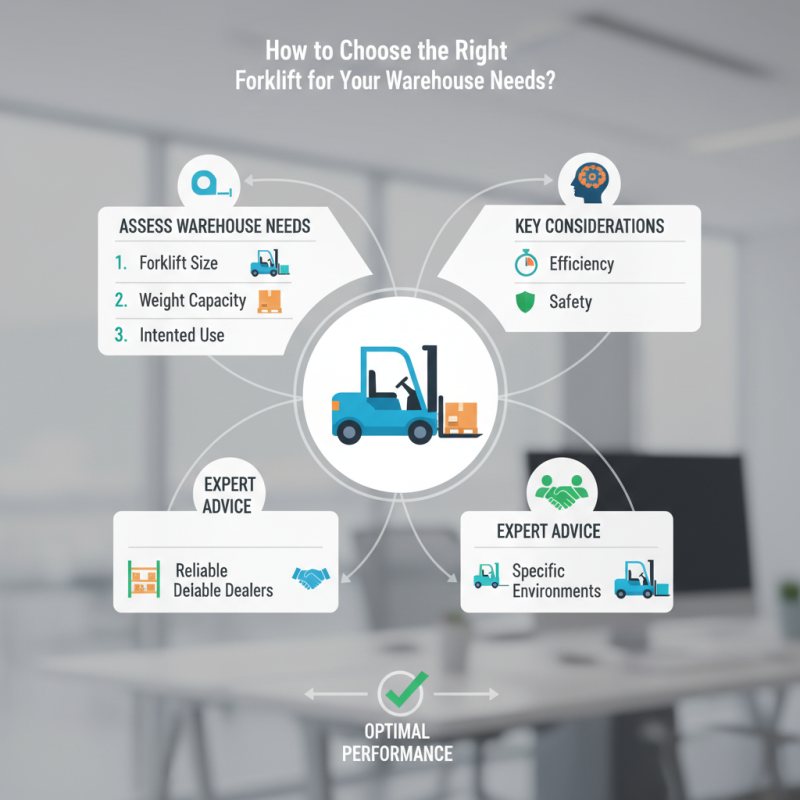
Choosing the right forklift for warehouse operations is crucial. It greatly impacts efficiency and safety. A well-selected forklift can streamline workflows, while a poor choice may lead to costly mistakes.
Understanding your specific warehouse needs is essential. Consider factors like forklift size, weight capacity, and intended use. A thorough assessment can prevent errors that affect productivity. Each warehouse has unique challenges, so a one-size-fits-all approach often fails.
When evaluating options, seek expert advice. Reliable dealers offer guidance based on their experience. Different environments require varying types of forklifts. For instance, narrow aisles may need compact models. Reflect on your operational needs to make an informed decision. Make sure the forklift matches your requirements to enhance overall performance.
Understanding Your Warehouse Environment and Requirements
When selecting a forklift for your warehouse, understanding your environment is crucial. Analyzing the layout of your space can reveal varying needs. If your aisles are narrow, a compact forklift is ideal. According to industry reports, 73% of warehouses utilize narrow aisle configurations. This statistic emphasizes the importance of a forklift that can maneuver efficiently in tight spaces.
Consider the weight of typical loads. The Occupational Safety and Health Administration (OSHA) suggests that the average forklift in warehouses lifts around 3,000 to 5,000 pounds. Choosing a forklift with sufficient capacity enhances safety and productivity. Notably, 68% of accidents involve improperly sized equipment, highlighting the need to match capacities to your loads.
Additionally, assess surface types and conditions. Forklifts operate differently on concrete, wood, or uneven surfaces. Choosing units with appropriate tires and suspension systems helps minimize risks. Reliability in operations is also key; warehouses report up to a 25% increase in efficiency when suitable equipment is utilized. Ignoring these aspects could lead to operational challenges and increased costs.
Evaluating Different Types of Forklifts and Their Features
When evaluating different types of forklifts for warehouse needs, it’s crucial to consider various features. Electric forklifts are growing in popularity. According to industry reports, they can reduce energy costs by 60% when compared to internal combustion models. Additionally, their lower maintenance requirements often mean fewer repair costs over time. However, electric forklifts typically have limited lifting capacity. This limitation may not suit all operations, especially in heavy-duty environments.
Another option is the diesel forklift. These machines are powerful and can handle heavier loads. They excel in outdoor environments where terrain may be rougher. Still, diesel forklifts emit exhaust gases. This factor can create air quality issues in enclosed warehouses. Companies must weigh these pros and cons before making a decision.
Some businesses might consider reach trucks. They are ideal for narrow aisles and maximizing vertical storage space. However, operating reach trucks requires skilled operators. Poor handling can lead to accidents or damage to inventory. Safety training is essential for effective operation. Ultimately, understanding the features and limitations of each type of forklift is key to making an informed choice for your warehouse.
Assessing Load Capacity and Forklift Size Specifications
Choosing the right forklift for your warehouse requires careful consideration of load capacity and size specifications. Start by assessing the loads you regularly handle. What is the weight of your heaviest items? This will help determine the necessary load capacity. Most forklifts have specific limits; exceeding them can lead to accidents or equipment failure.
Next, consider the size of your forklift. A compact design may be essential for narrow aisles or tight spaces. Be mindful of the lifting height you need as well. Some forklifts operate well in low-clearance areas, while others can reach significant heights. However, taller forklifts can be less stable, especially with heavy loads. It’s crucial to balance height requirements with stability needs.
Inspecting your warehouse layout is equally important. Measure aisle widths and check loading dock heights. A forklift that doesn’t fit well can hinder operations. Evaluate if your preferred choice offers versatility. Some forklifts can adapt to different tasks, but they may not specialize in any. Reflecting on these factors ensures you choose a forklift that meets your specific needs effectively.
Considering Safety Features and Compliance Standards
When selecting a forklift for your warehouse, safety features play a pivotal role. Look for models equipped with stability systems. These prevent tipping during operation. Check for automatic speed reduction in tight spaces. This is vital in reducing accidents. Enhanced visibility, such as a clear view mast, can significantly lower the chance of collisions. Proper lighting on the equipment also helps operators see clearly in low-light areas.
Compliance with safety standards is non-negotiable. Ensure your chosen forklift meets OSHA regulations and ANSI guidelines. This guarantees safety for operators and staff. Ask about additional features like alarms and seat belts. These can save lives in case of an accident. Regular maintenance is equally important. A well-maintained forklift reduces risk and enhances efficiency. Ignoring compliance can lead to severe repercussions.
Don’t rely solely on equipment specifications. Understand your specific warehouse needs. Each environment presents unique challenges. What works in one setting may not work in another. Reflect on your operations regularly. Adaptation is key in maintaining a safe workplace. Investing time in safety ensures a more efficient and secure environment.
How to Choose the Right Forklift for Your Warehouse Needs?
| Forklift Type |
Load Capacity (lbs) |
Maximum Lift Height (ft) |
Power Source |
Safety Features |
Compliance Standards |
| Electric Forklift |
3,000 |
20 |
Electric |
Auto-Break, Overload Protection |
OSHA, ANSI |
| Internal Combustion Forklift |
5,500 |
18 |
Gas/Diesel |
Stability Control, Fire Suppression |
EPA, ISO |
| Warehouse Stacker |
1,500 |
10 |
Electric |
Platform Safety, Speed Control |
CE, UL |
| Reach Truck |
4,500 |
30 |
Electric |
Tilt Control, Operator Presence System |
ISO, ANSI |
Budgeting for Purchase and Maintenance Costs of Forklifts
When budgeting for forklift purchases, it’s essential to consider both acquisition and long-term maintenance costs. Forklifts can range from $15,000 to $100,000, depending on type and capabilities. This price tag doesn't include maintenance, which can reach up to $1,500 per year. Proper budgeting includes factoring in these hidden expenses.
Routine maintenance is often overlooked. A well-maintained forklift lasts longer, minimizing replacement costs. Industry reports show that neglecting maintenance can lead to up to 20% more in operational costs. Notably, a forklift may require repairs every 2,000 operating hours, which can be costly. This underscores the need for proactive maintenance planning.
Fuel type also affects costs. Electric forklifts, for instance, have lower operational costs but higher upfront prices. In contrast, propane models may have lower initial costs but higher fuel expenses. Each option has trade-offs that impact your budget. Understanding these intricacies can aid in making informed decisions. Making the wrong choice could disrupt warehouse efficiency and inflate costs.
Conclusion
When considering how to choose the right forklift for warehouse operations, it is essential to begin by understanding your unique warehouse environment and specific requirements. This includes evaluating the available space, the types of goods handled, and any operational constraints that may influence forklift selection.
Next, assess the various types of forklifts available, focusing on their features to determine which aligns best with your needs. It's crucial to consider the load capacity and size specifications of the forklifts to ensure they can safely handle your inventory. Additionally, prioritize safety features and compliance standards to ensure a secure working environment. Lastly, budgeting for both the purchase and maintenance costs of the forklifts will help in making a sustainable choice that enhances overall warehouse efficiency.

 IDD Motion